
All-on-4 and All-on-6 Dental Implants in Reston, Virginia
Full-arch restoration on four or six implants is a proven method of restoring a complete smile, along with normal chewing function and speech. At our clinic, we have achieved success in 96–98% of cases.
What Is All-on-4?
“All-on-4” is a patented implant system owned by Nobel.
Nobel Biocare is a premium implant manufacturer headquartered in Switzerland, with roots going back to the pioneering implant research of Professor Per-Ingvar Brånemark in Sweden. Systems from this manufacturer are considerably more expensive than other implant systems. On this page, you will learn about all the available options for full-arch restoration — on 2, 4, or 6 implants — and be able to compare costs.
Placement Details
If there is a sufficient amount of healthy bone, we recommend placing 6 implants, which reliably support 10 teeth — enough to fully restore chewing function.
The current global standard in the dental community is to restore the arch with these systems up to the fifth or sixth tooth, without replacing the seventh and eighth (the molars at the very back).
In some situations, an acrylic (plastic) restoration can be the solution for full-arch treatment on four implants. Because it is lightweight, the chewing load is significantly lower, which reduces the risk of fracture.
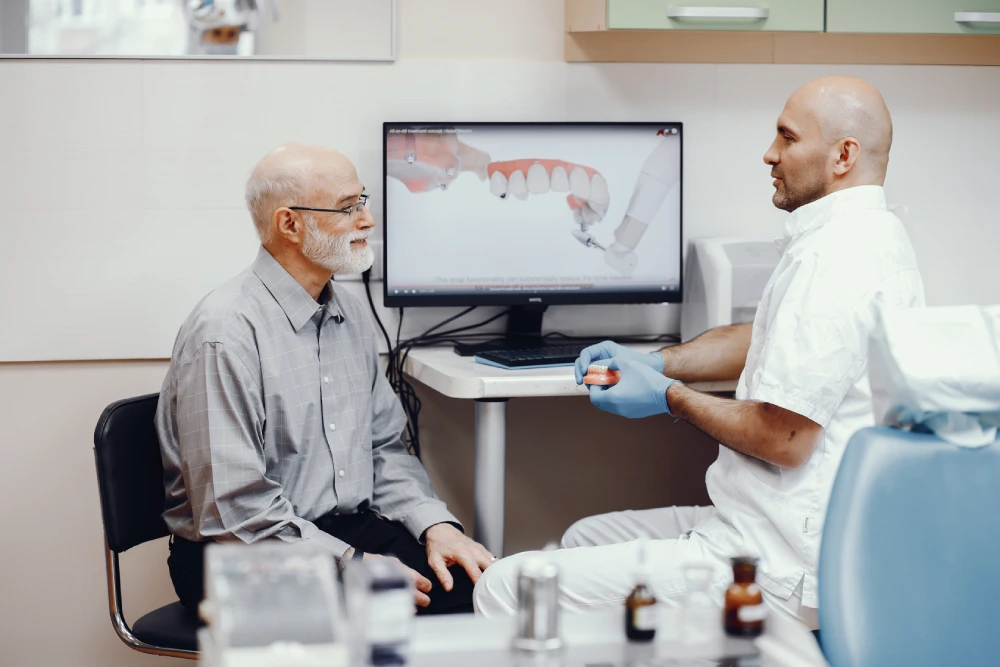
Only a doctor can determine the exact number of implants needed — after reviewing a CT scan of both jaws. The scan shows how strong, dense, and wide the bone is. The decision to place two, four, or six implants is made on an individual basis.с
Is "All-on-2" Possible?
If all the teeth are supported by just two implants, the restoration will be removable — like a conventional removable denture, but with additional retention. In this case, the dental implants provide stabilization: they prevent the denture from tipping and keep it from slipping while you talk or eat.
The implants hold the denture securely in place, eliminating the constant discomfort caused by an unstable appliance. You will no longer need to check its position all the time or hold it in place with your tongue.
If the alveolar bone (the bone into which the titanium root is placed) is healthy, we recommend placing 4 or more implants, and also considering a semi-removable restoration on telescopic crowns or a bar-retained system (bar overdenture). These are the most reliable and long-lasting options.
Come in for a consultation at our dental practice, where a surgeon and a prosthodontist will help you choose the most durable and cost-effective implant system for your needs.
How Is the System Placed?
All-on-4 is a restoration system supported by four implants, used when many or all teeth are missing in the upper or lower jaw.
Two implants in the front section are placed the same way as in standard implant treatment — perpendicular to the jaw — while the two rear implants, in the area of the 4th and 5th teeth (premolars), are placed at a 45-degree angle.
At the point where the crown is attached, an enormous concentrated load is created, which demands exceptional strength from the titanium root. Only a titanium root with an elastic modulus like that of Nobel implants can withstand the required angle.
Treatment at Our Clinic
Pal Family Dentistry offers an affordable alternative to Nobel’s “All-on-4” and “All-on-6” systems. Full-arch restoration with the Hiossen implant system is just as reliable and has earned a strong reputation among dentists worldwide. Let’s take a closer look at what makes these systems dependable and what you should pay attention to.
With 4 implants, up to 10 teeth can be restored, based on the calculation that 1 implant replaces 1.5 healthy teeth. The calculations also take into account the density of the restoration and the load generated during chewing. The patient receives a single one-piece zirconia restoration that replicates a full set of healthy teeth. Zirconia (zirconium oxide, or zirconium dioxide) is an extremely strong material used in dentistry that outperforms both ceramic and porcelain-fused-to-metal in every respect.
The one-piece restoration is fixed to the implants with screw connections, and the access holes are concealed with a discreet light-cured composite filling. This type of placement is similar to a dental bridge, only with a larger number of teeth.
What Determines the Cost of Full-Arch Implant Treatment
The price of a full-arch restoration is not a single number, and two patients with similar concerns can receive very different treatment plans. Several things shape the final figure.
- The number of implants. A restoration on two implants, four implants, or six implants involves a different amount of surgical work and different components.
- The material of the restoration. Acrylic, zirconia, and other options differ in strength, longevity, and laboratory cost.
- The implant system. We work with Hiossen, which gives our patients a reliable full-arch result at a lower cost than premium systems such as Nobel Biocare.
- The condition of the bone. If the alveolar bone has lost volume over the years, preliminary procedures may be needed before implants can be placed, and this is something a CT scan will show.
- Whether extractions are required, and how many.
What Your Treatment Plan Includes
After the consultation you receive a written treatment plan with an itemized estimate, so you can see exactly what each stage covers before you decide anything. Your plan will typically account for the initial examination and CT scan, the surgical placement of the implants, the temporary restoration you wear while healing, the final restoration, and the follow-up visits that come with it. We go through this document with you in the office, and you are welcome to take it home and think it over.
Insurance, HSA, and Payment Options
Many dental plans cover part of the cost of full-arch treatment, and coverage differs quite a lot from one plan to another. Our team will review your benefits with you and let you know what your plan is likely to apply toward treatment before you commit. Implant treatment is usually an eligible expense under HSA and FSA accounts, though we recommend confirming this with your plan administrator. Financing options are also available for patients who prefer to spread the cost over time. Call our Reston office or request a consultation online, and we will walk you through the numbers for your situation.
Which Option Is Right for Me?
The restoration can be fixed, semi-removable, or fully removable, and can be supported by 2, 4, 6, or more implants. The type of restoration and the exact number of implants depend on the patient’s individual health, as well as their muscle strength and chewing load.
Simply put, for the average woman, 4 implants are usually sufficient, because her jaw muscle strength is relatively low. A man aged 40–45, on the other hand, may need a 6-implant system due to a stronger chewing load. The two additional implants in the “all-on-six” system add strength and reliability to the restoration when zirconia is used.
Frequently Asked Questions
How much do All-on-4 dental implants cost in Reston?
The cost depends on the number of implants, the material of the restoration, and the condition of your bone, so we prefer to give you a real figure rather than a general one. After an examination and a CT scan you receive a written estimate for your own case. The consultation is where that conversation starts, and there is no obligation to proceed.
Is All-on-6 more expensive than All-on-4?
A six-implant restoration involves two additional titanium roots and the components that go with them, so the treatment is more involved. Whether it is the right choice for you depends on your bone volume and your chewing load rather than on budget alone. For some patients four implants are entirely sufficient, and for others the additional support is worth it.
Does dental insurance cover full mouth dental implants?
Many plans contribute toward full-arch treatment, and the amount varies widely between policies. We will review your benefits with you and explain what your plan is likely to apply before treatment begins.
What is the difference between All-on-4 and All-on-6 dental implants?
The number of supporting implants is the main difference. Four implants can carry up to ten teeth, while six implants distribute the chewing load across a wider base and add strength when a zirconia restoration is used. Your surgeon will recommend one or the other after reviewing your CT scan.
Are there more affordable alternatives to the Nobel All-on-4 system?
Yes. All-on-4 is a trademarked system from Nobel Biocare, and full-arch restoration itself can be performed with other well-established implant systems. We use Hiossen, which has a strong reputation among clinicians worldwide and allows us to offer full-arch treatment at a more accessible cost.
How long do full-arch dental implants last?
With good home care and regular check-ups, implants are designed to serve for many years, and zirconia restorations hold up well under daily chewing. We will show you how to care for your restoration and see you for routine follow-ups.




