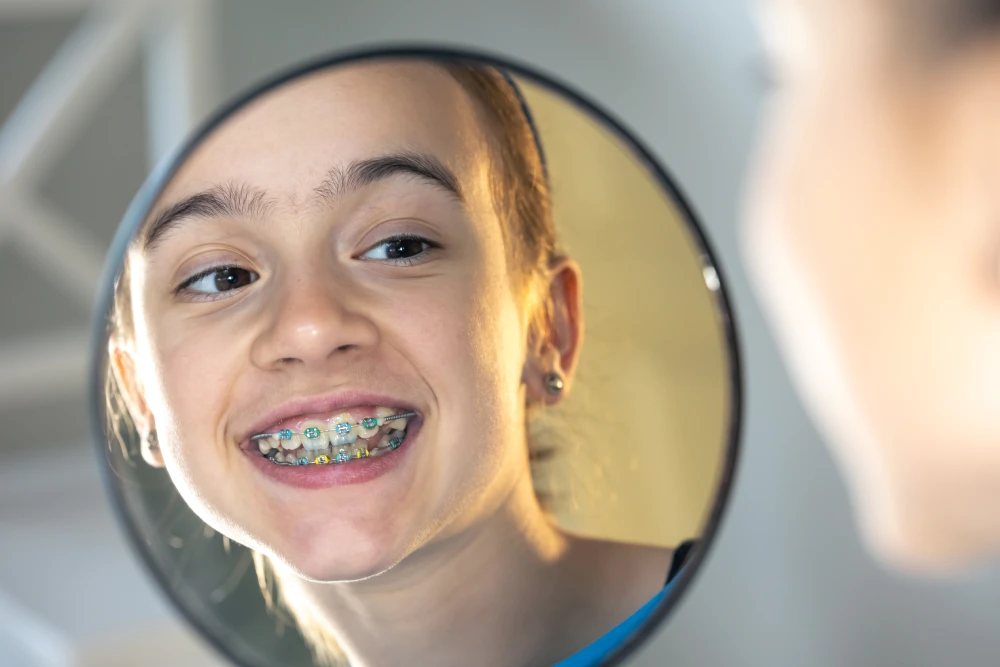

Braces in Reston, Virginia
A straighter, healthier smile is closer than you think. Braces are a system of small brackets and a thin archwire that gently guide your teeth into their ideal position, correcting the bite and alignment little by little, comfortably and predictably.
Here’s how it works. The brackets are bonded to the teeth with a special dental adhesive, and a flexible archwire is placed into each bracket. The wire gently and continuously encourages the teeth to move toward their correct position. The wire can be held in place with small colored elastic rings called ligatures. These are conventional braces, and kids especially love picking their colors at every visit. More modern systems hold the wire with tiny built-in clips. These are self-ligating braces, which often mean fewer adjustments and shorter appointments.
Braces come in two placements: labial (on the front surface of the teeth) and lingual (on the inner surface, facing the tongue, essentially invisible to others). They also come in a range of materials, so there’s an option for every smile, lifestyle, and budget:
- metal
- plastic
- ceramic
- sapphire
- combination
Getting Used to Your Braces
The first week is an adjustment period, and it’s easier than most patients expect. Here’s what’s completely normal:
Mild soreness for the first few days as your teeth begin to move. It fades quickly, and over-the-counter comfort measures are usually all it takes.
A slight change in speech that resolves on its own as you adapt, usually within days.
A little rubbing on the cheeks or lips at first. We’ll give you special orthodontic wax that solves this instantly.
Some new eating habits. We’ll walk you through which foods to enjoy and which to set aside during treatment. Most patients adapt within a week or two.
Like any medical treatment, orthodontics has rare potential complications, things like enamel wear, gum inflammation, or sensitivity around the roots. The good news: these are uncommon and, most importantly, preventable. Regular checkups with your orthodontist and good daily hygiene keep your treatment safe from start to finish. That’s exactly why we stay by your side throughout the entire journey, monitoring every step so small things never become big ones.

Your Treatment Journey, Step by Step
Every smile is different, so every treatment plan is personal. Here’s what the path looks like:
A friendly first consultation. Your doctor examines your smile, listens to what you’d like to change, and walks you through your options, including timing and costs, in plain, no-pressure language. We’ll also take panoramic and cephalometric X-rays to see the full picture.
Impressions and planning. We take impressions and review your X-rays together. If your teeth need a little preparation first (a cleaning or a filling), we’ll take care of that so your braces start on a healthy foundation.
Placement day. Once everything looks good, your braces are placed in a single comfortable visit. Before you leave, we’ll show you exactly how to care for them, share simple diet tips, and select hygiene products chosen just for you.
Easy check-in visits. You’ll see us about once a month (conventional braces) or once every two months (self-ligating braces). These visits are short and gentle. We adjust or replace the wire and make small refinements that keep your teeth moving smoothly. Everyone’s teeth move at their own pace, and we tailor each visit to yours.
Steady progress. On average, treatment takes anywhere from six months to three years, depending on your smile. Before the finish line, we take one more panoramic X-ray to confirm everything is exactly where it should be.
Protecting your new smile. Once your braces come off, a discreet retainer, either a clear removable one or a slim fixed one, keeps your results beautiful for years to come. For children, we recommend one to three years of wear. For adults, the longer, the better. And we’ll keep seeing you for easy six-month checkups.
A Word About Lingual ("Invisible") Braces
Braces placed on the inner side of the teeth are a wonderful choice for patients who want completely discreet treatment. It’s fair to know a few things upfront. They cost more than traditional braces, the first weeks of adjustment take a bit more patience (the tongue needs time to get used to its new neighbors), and treatment can take somewhat longer. For many of our patients, the invisibility is well worth it, and we’ll help you decide honestly whether it’s the right fit for you.
Choosing Your Colors
One of the small pleasures of conventional braces is that you get to choose. The ligatures, those little elastic rings that hold the wire in place, come in a wide range of shades, and you can pick a new combination at every visit.
Some patients go bold with black braces, which look sharp and modern and hide staining from coffee or dark foods better than lighter shades. Red and dark red braces are perennial favourites, especially around the holidays. Others prefer to stay subtle with clear, white or silver tones that sit quietly against the teeth.
Children in particular look forward to this part, and we keep the full range on hand so there is always something to choose from. If you would rather your braces stayed as discreet as possible, ceramic or sapphire brackets with clear ligatures are the way to go.